
(1) PVX-4
PVX-4 is an innovative DNA therapeutic vaccine designed by fusing the E6, E7, and L2 genes of HPV 16 with Calreticulin (CRT). It utilizes the proprietary TriGrid™ electroporation system to achieve highly efficient intracellular delivery.
In the Phase I clinical trial conducted at Johns Hopkins University (JHU) and the University of Alabama at Birmingham (UAB), PVX-4 demonstrated an excellent safety profile alongside compelling efficacy data: nearly 80% of patients achieved complete clearance of the HPV 16 virus, and their cervical high-grade precancerous lesions regressed completely. Notably, this therapy maintained its efficacy within the immunocompromised HIV-positive population, fully validating the exceptional and potent immuno-activating capabilities of PVX-4.
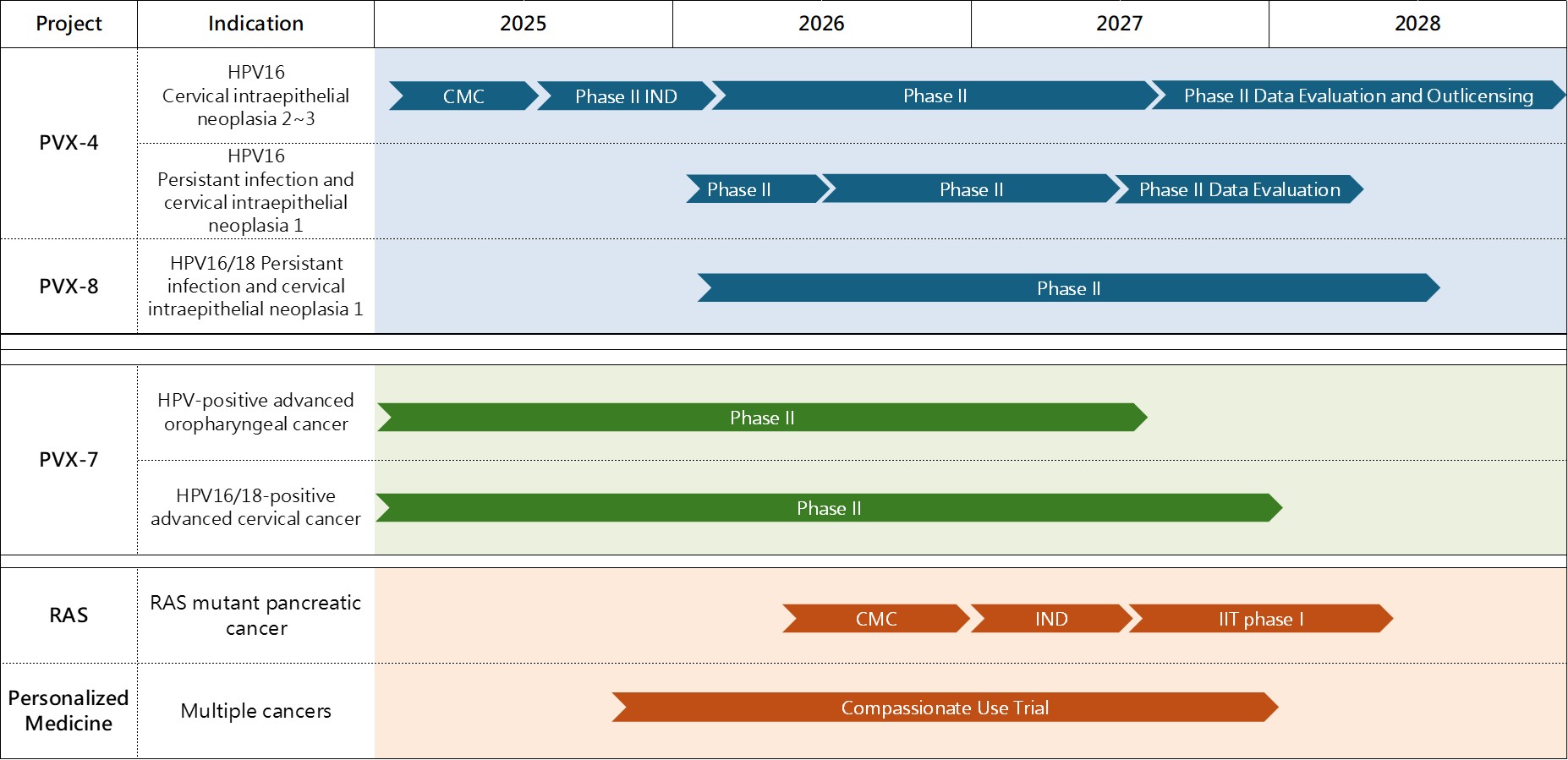
Building upon the remarkable outcomes of the Phase I trial, we are actively expanding our Phase II clinical footprint to further validate its dual efficacy in “viral clearance” and “lesion regression.” Our current dual-track plan includes a Phase II clinical trial for cervical high-grade precancerous lesions, as well as a Phase II clinical trial for persistent HPV 16 infection conducted in partnership between Papivax Biotech and the Asian Gynecologic Oncology Group (AGOG). To date, the program for cervical high-grade precancerous lesions has officially received Phase II clinical trial approvals from both the US FDA and Taiwan TFDA, and patient enrollment is now fully underway.
(2) PVX-7
PVX-7 is an innovative DNA vaccine comprising the E6, E7, and L2 genes of HPV types 16 and 18 fused with heat shock protein 70 (HSP70) molecules. Administered via standard intramuscular injection, the regimen employs a prime-boost strategy: the first two doses consist of the DNA vaccine, followed by a recombinant vaccinia virus encoding HPV genes (TA-HPV) as the third dose to boost the immune response. PVX-7 is designed to treat advanced cervical cancer and oropharyngeal cancer caused by HPV infections.
Currently, Papivax Biotech is partnering with the Vanderbilt University Medical Center (VUMC) to conduct a Phase II clinical trial evaluating PVX-7 in combination with an immune checkpoint inhibitor for the treatment of advanced oropharyngeal cancer (NCT05799144). Furthermore, the company’s Phase II clinical trial protocol evaluating PVX-7 combined with immune checkpoint therapy for cervical cancer has successfully received clearance from the US FDA (IND 27465).
(3) PVX-8
Currently, the medical community offers no effective therapeutic options for patients with persistent cervical HPV 16 infection concurrent with low-grade precancerous lesions (including ASC-US, ASC-H, LSIL, and CIN1). These patients are left in a state of anxious “watchful waiting,” relying solely on follow-up visits every 6 to 12 months for repeated Pap smears and HPV DNA testing. They must wait indefinitely to see whether their infection will spontaneously clear or progress into high-grade lesions or invasive cancer—a process that undoubtedly inflicts severe psychological anxiety and emotional distress, often compounded by social stigma.To address this critical gap, PVX-8 was developed as an innovative DNA vaccine comprising the E6, E7, and L2 genes of HPV 16 and 18, fused with heat shock protein (HSP) molecules. Administered via the proprietary TriGrid system, PVX-8 is designed to treat persistent HPV 16 and 18 infections. At present, manufacturing for both the investigational drug product and the matching placebo has been completed, and the Phase II clinical trial for PVX-8 is set to launch in 2026.
(4) RAS
Given that 80–95% of pancreatic ductal adenocarcinomas (PDAC) harbor specific KRAS mutations (such as G12D and G12V), Papivax has selected these public neoantigens as its primary target. The company has designed a therapeutic DNA vaccine that triggers a potent and mutation-specific cytotoxic T-cell (CD8+ T cell) immune response against RAS mutations. This candidate has already demonstrated robust anti-tumor efficacy, significantly inhibiting the growth of RAS-mutated tumors in humanized mouse models.
In terms of development strategy, Papivax is adopting an accelerated development pathway. Since the safety profiles of the DNA vector and Calreticulin (CRT) technology have already been clinically validated in other trials, the company intends to request a waiver from the FDA for preclinical safety toxicology studies. Moving forward, the project will be advanced through Investigator-Initiated Trials (IIT) to streamline administrative procedures and mitigate development risks, with the ultimate goal of securing an early-stage international out-licensing agreement following an expedited Phase I clinical trial.
(5) Personalized Precision Medicine
Papivax Biotech is further extending the application of its two core technologies- the CRT DNA nucleic acid vector platform and the TriGrid automated electroporation delivery system—into the highest tier of precision medicine. By collecting tumor tissue and blood samples from advanced cancer patients for next-generation sequencing (NGS) and MHC genotyping, the company utilizes advanced databases to predict mutant sequences with the highest immuno-activating potential, thereby tailoring a bespoke therapeutic pathway for each individual patient.
Furthermore, Papivax has established a formidable advantage within its manufacturing supply chain. Its GMP manufacturing partner possesses proprietary lentiviral vector design capabilities alongside extensive FDA inspection experience. This enables them to meet the flexible, small-batch production demands required for personalized vaccines, rapidly manufacturing customized patient-specific vaccine DNA within approximately 1 to 3 months. This technological breakthrough successfully bypasses the high-cost and time-consuming bottlenecks characteristic of traditional cell therapies, strategically positioning Papivax to capture a share of the global personalized cancer vaccine market, which is projected to exceed USD 12 billion by 2035.